
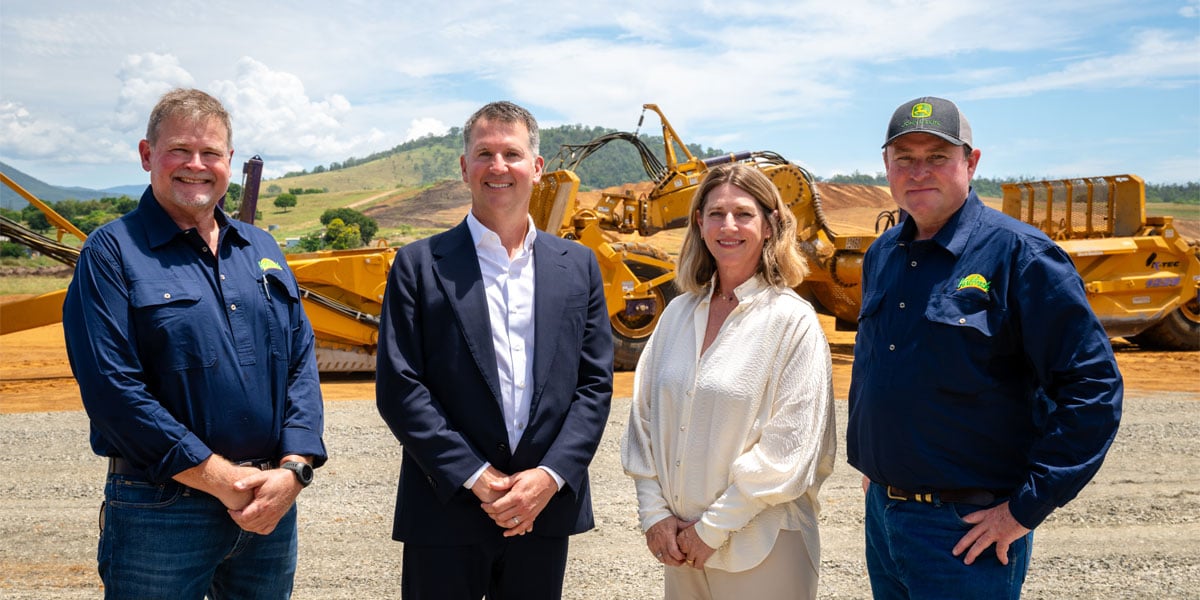
 L-R: Kalfresh founder Robert Hinrichsen, Wollemi Capital co-CEO Tim Bishop, QIC CEO Kylie Rampa and Kalfresh CEO Richard Gorman at the Scenic Rim Agricultural Industrial Precinct in Kalbar
Food, fuel, fertiliser and power, all from the same paddocks, all from Queensland.
QIC has partnered with Wollemi Capital to make an $80 million consortium investment in Australia’s first integrated food and energy precinct, led by trusted Queensland vegetable growers, Kalfresh.
The Kalfresh Bioenergy Facility will transform locally produced food and farm waste into renewable electricity and natural gas for Queensland industry and transport, as well as sustainable fertiliser for farmers.
Anchoring the new Scenic Rim Agricultural Industrial Precinct at Kalbar, the facility creates a hub for value-adding agricultural ingredients to deliver circular-economy benefits for local producers and manufacturers, and new income opportunities from feedstock supply.
QIC CEO Kylie Rampa said the investment represents a significant step forward in demonstrating the commercial viability and scalability of bioenergy from the paddock up.
Alongside Wollemi Capital, QIC is pleased to support Kalfresh as they lead the way in introducing a scalable bioenergy platform to Queensland, demonstrating how agriculture and clean energy can work hand in hand
Kylie Rampa - QIC CEO
“Farmers understand both the challenges and opportunities of decarbonisation better than most, and their leadership is central to creating solutions that work in practice.
“Bioenergy is a proven, reliable technology used around the world, and Kalfresh has brought forward a practical vision for Australia’s first scaled deployment designed specifically for Queensland conditions.
“This unlocks a model that can be replicated in farming regions right across the state, enhancing our energy security while capturing value from what was traditionally considered waste.”
Kalfresh co-owner and Chief Executive Officer Richard Gorman said it’s a simple, proven technology used extensively overseas to turn agricultural waste into power, renewable natural gas fuel and fertiliser.
This is a practical and proven renewable energy system that gives us so many options
Richard Gorman - Kalfresh Co-owner & CEO
“We can produce renewable gas to fuel vehicles and power homes and industry with farm waste inputs. Anaerobic digestion is a natural process where microbes break down organic matter to produce gas and we’ll use the by-product, digestate, as a natural fertiliser on farm.
“It’s a closed loop system that returns many benefits. It reduces emissions, supports farmers, decarbonises industry and transport and boosts local jobs.
“We’re proud to be leading this project and we’re excited to be partnering with QIC and Wollemi in a consortium bringing to market a wide range of renewable products, including new baseload generation to the energy market.”
Wollemi Co-Founder and Co-CEO Tim Bishop said the project is shovel-ready climate infrastructure.
We’re backing this because it’s real, reliable and replicable – a model where agriculture and clean energy work together, underpinned by economics that stand up at scale.
Tim Bishop - Wollemi Co-Founder & Co-CEO
The Bioenergy Facility construction will be staged and at full capacity could:
- Power up to 31,000 homes, or
- Fuel up to 98-million kilometres of truck, bus and tractor travel with renewable natural gas (RNG)
- Abate up to 430,000 tonnes of CO₂ emission annually, equivalent to planting 21-million trees a year
- Replace synthetic fertilisers with digestate bio-fertiliser, improving soil health and reducing import reliance
Anaerobic digestion (AD) technology has been operating in Europe and America for decades and is already powering homes and industry, including fleets of trucks for Amazon and UPS, and public buses in the UK, Germany, Paris, LA and New York.
This will be the first scaled deployment of the system in an Australian farming region, designed for Queensland conditions.
Construction will begin in February 2026, with the first clean energy scheduled to flow from mid-2027.
The SRAIP will bring approximately 1000 new jobs into the region during construction and in operation, including up to 475 permanent positions.


Heading
This is rich text for accordion 1
Cypress Creek Renewables (CCR) is a leading renewables IPP. CCR develops, finances, owns and operates utility-scale and distributed solar and energy storage projects across the United States. The mission is to power a sustainable future, one project at a time. Since inception, CCR has developed more than 11GW of solar projects. Today CCR owns 1.7GW of solar, and through its O&M Services business, operates 4GW of solar projects. For more information about Cypress Creek, please visit www.ccrenew.com
This is rich text for accordion 3