

Recent regulatory attention has sharpened scrutiny of private debt valuations and the practices and governance that support them.
For institutional investors, the question is not only whether reported returns are resilient, but whether the valuation process behind them is transparent, current and subject to robust governance.
Key takeaways
- ASIC's focus on valuations, alongside its broader review of private debt practices and governance, reflects a maturing market and a growing emphasis on valuation integrity.
- In private debt, investor confidence depends less on a single reported value and more on the quality, consistency and transparency of the valuation process.
- As conditions become more variable, disciplined underwriting and valuation frameworks become more important.
Why is ASIC focusing on private debt valuations?
Attention on Australian private debt has increased as the market has matured. In Australia, that attention has been reinforced by ASIC's recent focus on valuation practices alongside its broader review of practices and governance in private debt. ASIC has called for current and accurate asset valuations grounded in realistic assumptions.
That scrutiny should not be confused with broad deterioration in credit quality. Current conditions are more uneven and have the potential to create greater dispersion in outcomes, particularly where underwriting has been weaker. That makes it more important to distinguish resilient credits from weaker credits and borrower-specific problems.
When credit performance is strong and refinancing is readily available, the gap between reported values and economic reality may not be tested in a meaningful way. When borrower performance becomes less consistent, refinancing requires more selectivity and the cost of capital is higher, valuations become one of the primary ways underlying risk is recognised and priced over time.
"As the market's footprint expants, the rigour of valuation, governance and disclosure becomes more consequential."
The Australian private debt market has grown alongside its role in institutional portfolios. EY-Parthenon's 2026 Australian Private Debt Market Overview reports a 21% compound annual growth rate over the past decade, with assets under management reaching A$234.5 billion in 2025. As the market's footprint expands, the rigour of valuation, governance and disclosure becomes more consequential.
Why do private debt valuations require a different lens?
In public markets, investors can often test value against observable prices. Private debt is different. Loans are typically illiquid, borrower-specific and not frequently traded, so there may be no direct market price against which value can be tested.
That does not make valuation arbitrary. It means confidence depends less on a single reported number and more on the quality of the process used to arrive at it.
"Loans are typically illiquid, borrower-specific and not frequently traded, so there may be no direct market price against which value can be tested."
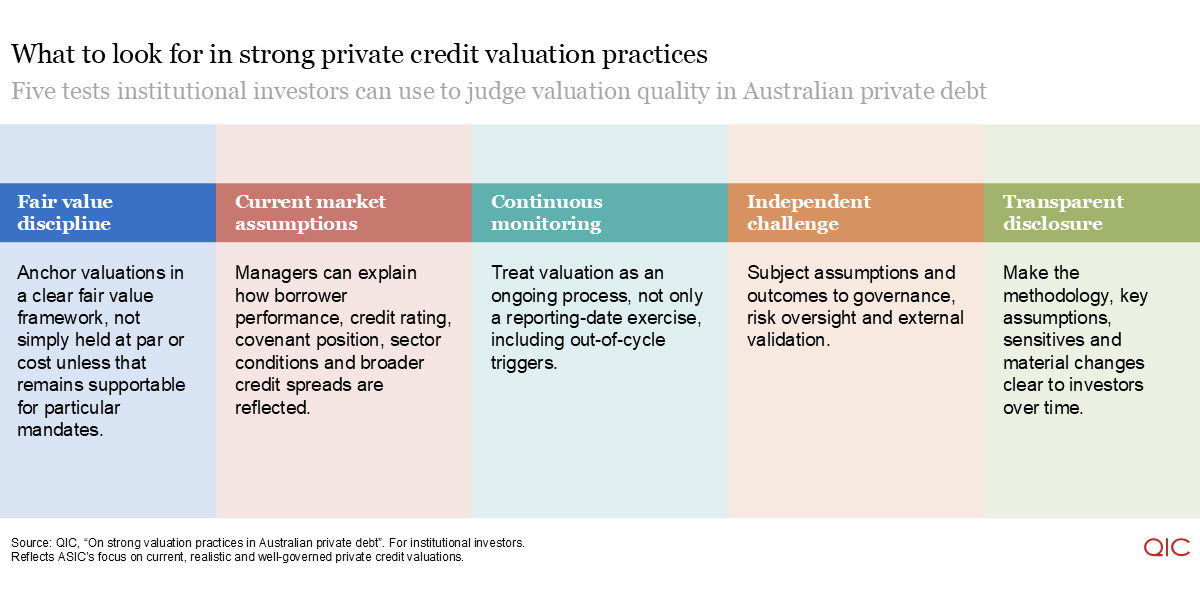
For investors, the relevant questions are practical: is the methodology clear? Are assumptions refreshed as conditions change? Is borrower performance connected to valuation? Is the outcome subject to governance and independent review?
What makes a strong private debt valuation framework?
Strong valuation practice starts with a clear methodology that can be applied consistently over time. For private debt, that means assessing expected cashflows, borrower performance, credit rating, covenant position, leverage, liquidity, sector conditions and relevant market signals, then testing whether those factors are appropriately reflected in valuation assumptions.
Where observable inputs are limited, judgement is required. In the Australian market, comparable data can be uneven because issuance volumes and secondary activity are more limited. Managers therefore need to draw on a combination of reference points, including recent deal margins, broader credit spreads and borrower performance. That judgement should be structured, documented and subject to challenge.
"Valuations should not be revisited only at formal reporting dates or after stress has become obvious."
Responsiveness is also critical. Valuations should not be revisited only at formal reporting dates or after stress has become obvious. They should evolve as borrower performance changes, refinancing conditions shift or market pricing indicates a different view of risk.
QIC's approach to fair valuation
For QIC Private Debt Australia, fair valuation is informed by recognised valuation principles, including IFRS 13 Fair Value Measurement, and applied through a structured, repeatable process. The objective is to determine the price at which an asset would trade in an orderly transaction between market participants at the measurement date.
In practice, this involves modelling expected cashflows and discounting them to present value using a rate that reflects both the time value of money and the risk profile of the asset. The mechanics are widely adopted. The discipline sits in the inputs.
Cashflow expectations need to be realistic. Discount rates need to reflect prevailing market conditions and the borrower's credit risk. Both need to change as conditions change.
QIC monitors broader movements in private credit spreads, recent transaction pricing where relevant and other market indicators. These signals inform judgement rather than acting as mechanical valuation inputs. They help keep valuations connected to economic reality and ensure macroeconomic and borrower-specific factors are appropriately reflected.
Valuation is intrinsically linked to ongoing monitoring. Borrower performance and credit ratings, leverage, liquidity, covenant position, sector conditions and broader market observations all feed into reassessed assumptions. Out-of-cycle triggers may also warrant formal reassessment, including material credit spread movements or borrower-specific changes in financial performance or outlook.
Independence is embedded through governance and review. External validation is used to review methodology and valuations, including challenging assumptions. Investment Committee oversight and endorsement, together with Valuations Oversight Committee approval, provide further scrutiny. Both committees include the Chief Risk Officer and have independent chairs.
What should investors look for in strong valuation practice?
Australian private debt opportunities remain, but discipline matters
In QIC's view, Australian private debt may offer attractive opportunities for institutional investors, supported by bank disintermediation, more selective liquidity conditions and demand for flexible capital. The increased emphasis on valuation and broader market practices does not diminish that opportunity set.
What is changing is the importance of process. In a more mature market, outcomes are more likely to reflect the quality of underwriting, the strength of governance and the consistency with which valuation practices are applied.
"In a more mature market, outcomes are more likely to reflect the quality of underwriting, the strength of governance and the consistency with which valuation practices are applied."
For institutional investors, valuation discipline is therefore not a technical footnote. It is an important barometer of investment discipline and of the quality and reliability of an investment process. Increased scrutiny should be welcomed as a sign of a more mature market, not a less attractive one.
FAQs
What is fair value in private debt?
Fair value is a valuation approach that seeks to reflect the price that would be received to sell an asset in an orderly transaction between market participants at the measurement date.
Why are private debt valuations receiving greater scrutiny?
As private debt becomes a more established part of institutional portfolios, regulators and investors are paying closer attention to how managers recognise, govern and disclose valuation risk.
How often should private debt valuations be reviewed?
Strong practice treats valuation as an ongoing monitoring discipline, not only a reporting-date exercise. Reviews should respond to borrower performance, covenant position, refinancing conditions and market signals.
What governance should support private debt valuations?
Investors should look for documented methodology, independent challenge, risk oversight, external validation where appropriate and transparent disclosure of assumptions and material changes.
This Information may be based on information and research published by others. No QIC Party has confirmed, and QIC does not warrant, the accuracy or completeness of such statements. The views, opinions and market observations expressed are those of QIC as at the date of publication and are subject to change without notice.
QIC Limited ACN 130 539 123 (“QIC”) is a wholesale funds manager, and its products and services are not directly available to, and this document may not be provided to any, retail clients. QIC is a company government owned corporation constituted under the Queensland Investment Corporation Act 1991 (QLD). QIC is also regulated by State Government legislation pertaining to government owned corporations in addition to the Corporations Act 2001 (Cth) (“Corporations Act”). QIC does not hold an Australian financial services (“AFS”) licence and certain provisions (including the financial product disclosure provisions) of the Corporations Act do not apply to QIC. Other wholly owned subsidiaries of QIC do hold AFS licences and are required to comply with relevant provisions of the Corporations Act. QIC also has wholly owned subsidiaries authorised, registered or licensed by the United Kingdom Financial Conduct Authority (“FCA”), the United States Securities and Exchange Commission (“SEC”) and the Korean Financial Services Commission. For more information about QIC, our approach, clients and regulatory framework, please refer to our website www.qic.com or contact us directly.