
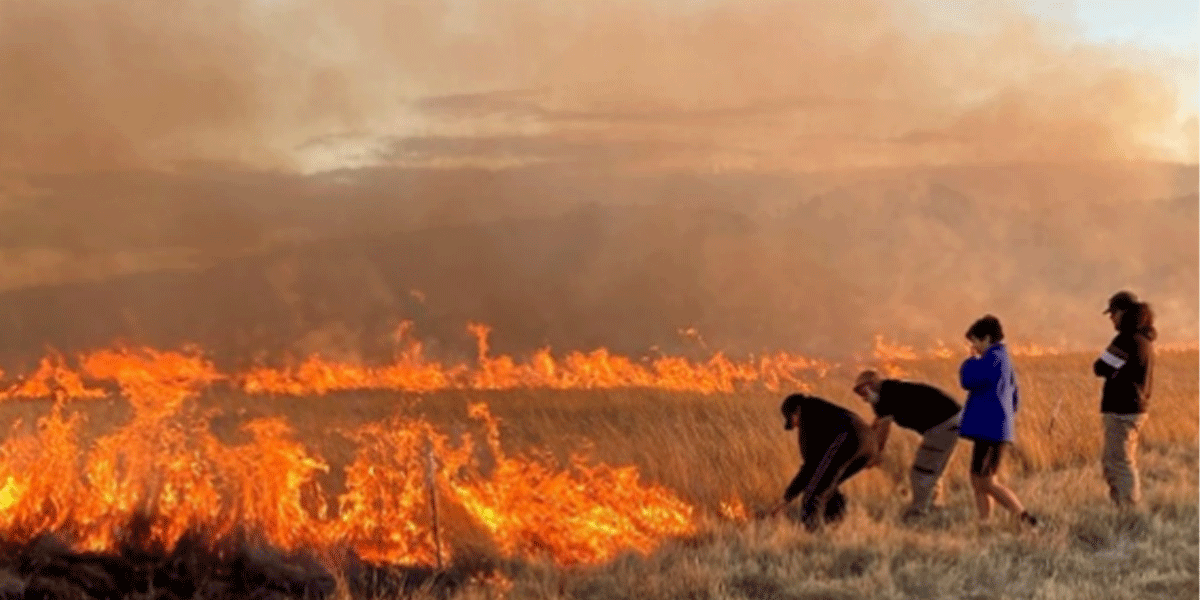
 Image: Hobart Airport cultural burn, 2023.
Situation
Hobart International Airport (HIA), in which QIC holds an equity share, is home to a critically endangered, Commonwealth-listed grassland, which airport management is responsible for managing and maintaining.
Together with the Tasmanian Aboriginal Centre (TAC)*, Hobart Airport undertook its second savanna burn on airport land using traditional fire knowledge to complete the Indigenous cultural burn of the nationally significant grassland.
This follows the airport’s first Indigenous cultural burn which took place in 2021.
Approach
Indigenous cultural burning was identified as the most appropriate management solution to maintain the biomass (thickness) of the grassland. Leveraging the expertise and knowledge of Aboriginal Australians, this technique preserves the significant biodiversity of the grassland over time.
Grassland species benefit from this low intensity and slow burn approach, resulting in improved soil health and reduced biomass of grasses and allowing threatened herbs to regenerate and flourish over time. The slower speed of this burn technique also benefits animals and insects, giving them time to move to a safe area. Hobart Airport employees played a key role in preparing the site: slashing the burn boundary, providing vehicle access and fittings for water points, and arranging the appropriate permits required.
The burn was conducted over an 8-hour period, with 6-7 people engaged, ranging from experienced rangers through to younger members of the community. Information regarding the burn was shared in advance with stakeholders across the precinct, including Air Traffic Control, ARFF (aviation rescue), local neighbours, tenants, council and the community.
Importantly, by implementing Indigenous land management practices, TAC has the opportunity to share this practice with other community members, ensuring the skills and knowledge are passed on to future generations.
Outcome
The use of this traditional fire knowledge forms part of HIA’s Reconciliation Action Plan and is one of the ways it commits to learning from the local Indigenous community.
An initial ecological survey following an earlier cultural burn in 2021 supported the effectiveness and continuation of this approach. The assessment found the trial burn may have provided a benefit to the grasslands, with one monitoring area burnt in 2021 showing a higher diversity and coverage of forbs (a flowering plant) and a lower percentage of bare ground compared to the other two monitoring sites.
“Seeing how TAC used fire to manage the grasslands was quite the eye opener. From a safety perspective, using fire seems like a high-risk option on airport grounds but the way they were able to manage the slow burn was impressive. What also struck me was the way the experienced rangers shared their knowledge so it was being passed on to future generations.” - Craig Riley, Head of Risk and Safety, Hobart Airport.
* TAC is an Aboriginal organisation with the objective to provide benevolent relief of poverty, sickness, destitution and distress to address disadvantage among Aboriginal and Torres Strait Islander (‘Aboriginal’) people.
Watch the video
Further information
QIC Limited ACN 130 539 123 (“QIC”) is a wholesale funds manager and its products and services are not directly available to, and this document may not be provided to any, retail clients. QIC is a company government owned corporation constituted under the Queensland Investment Corporation Act 1991 (QLD). QIC is also regulated by State Government legislation pertaining to government owned corporations in addition to the Corporations Act 2001 (Cth) (“Corporations Act”). QIC does not hold an Australian financial services (“AFS”) licence and certain provisions (including the financial product disclosure provisions) of the Corporations Act do not apply to QIC. Other wholly owned subsidiaries of QIC do hold AFS licences and are required to comply with relevant provisions of the Corporations Act. QIC also has wholly owned subsidiaries authorised, registered or licensed by the United Kingdom Financial Conduct Authority (“FCA”), the United States Securities and Exchange Commission (“SEC”) and the Korean Financial Services Commission. For more information about QIC, our approach, clients and regulatory framework, please refer to our website www.qic.com or contact us directly.
For more information about QIC, our approach, clients and regulatory framework, please refer to our website www.qic.com or contact us directly.
The statements and any opinions in this document (the “Information”) are of a general nature and for commentary purposes only and do not take into account any investor’s personal, financial or tax objectives, situation or needs. The Information is not intended to constitute and should not be relied on as personal legal or investment advice and it does not constitute, and should not be construed as, an offer to sell or solicitation of an offer to buy, securities or any other investment, investment management or advisory services.